
Winning Before the Checkout
Written by: Gabriella Jessica
In our previous article, we argued that double-date campaigns like 8.8 or 11.11 don’t create demand, they capture it. By the time consumers reach the checkout page, most have already decided which brands they trust, recognize, or feel comfortable buying. Discounts may influence when people purchase, but they rarely determine which brand they choose.
That raises an important question. If consumers have already made up their minds before the campaign begins, where does that decision actually happen? The answer isn’t inside an e-commerce platform. It happens gradually through hundreds of small moments people experience every day.
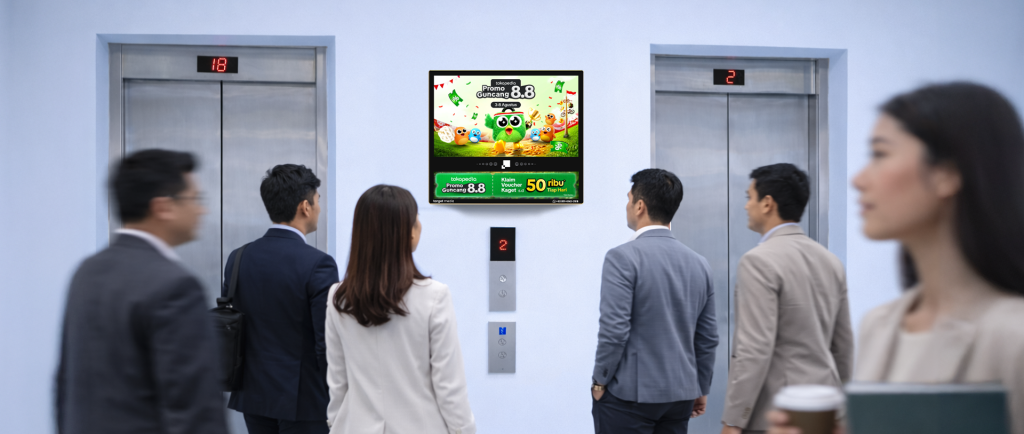
Think about a typical weekday. A brand appears on a screen in an office lobby, on a digital display inside a fitness center, or while someone waits for an elevator. None of these encounters feel like they’re driving an immediate purchase, yet together they create something far more valuable: familiarity.
Why Familiarity Matters
This idea has been studied for decades. In 1968, psychologist Robert Zajonc introduced what is now known as the mere exposure effect, showing that people naturally develop a preference for things they encounter repeatedly, even if they don’t consciously remember seeing them. More recent research confirms the same pattern: repeated exposure increases familiarity, and familiarity leads to greater liking.
For marketers, familiarity is more important than simple awareness. Consumers don’t need to remember every advertisement they’ve seen. What matters is…. whether a brand comes to mind naturally when a buying opportunity appears.
Marketing researchers Byron Sharp and Jenni Romaniuk describe this as mental availability: the likelihood that a brand is recalled in buying situations. They also introduce the concept of category entry points, the everyday occasions that trigger consumers to think about a product category. Someone leaving work late may think about food delivery, while someone preparing for an important meeting may suddenly realize they need skincare or coffee.
The more often a brand is present in these everyday situations, the stronger its association becomes. That’s why exposure in places like office buildings, gyms, cafés, or transit areas isn’t designed to generate immediate sales. Its role is much simpler: ensuring the brand already feels familiar when consumers eventually enter the market.
Presence Beats Repetition
Of course, being present doesn’t mean appearing everywhere all the time. Research consistently shows that advertising follows the law of diminishing returns. Repeated exposure improves recall only up to a certain point, after which excessive repetition can create irritation instead of preference.
Studies on digital signage have found similar results. Recall continues to increase with repeated exposure, but eventually reaches a plateau, particularly in environments people visit every day such as offices, gyms, or retail centers. The lesson is clear: consistency matters more than sheer frequency.
This helps explain why out-of-home advertising continues to perform strongly on brand recall. Industry studies have repeatedly shown that advertisements encountered during everyday routines are remembered better than many traditional media channels. When combined with digital advertising, recall becomes even stronger, allowing each channel to reinforce the other.
Winning Before Consumers Start Shopping
Indonesia offers a good example of why this matters. According to DataReportal’s Digital 2026: Indonesia report, more than 230 million Indonesians are connected to the internet. Yet only a small portion of their day is spent inside shopping platforms. Most of their time is dedicated to working, commuting, socializing, exercising, or simply moving between places.
That means brands have many more opportunities to influence memory than they do to influence purchases. By the time consumers open an e-commerce app during 8.8 or 11.11, they are usually comparing brands they already recognize. The competition is no longer about discovery, but about recall.
Showing Up Before They Need You
This perspective is also changing how media should be planned. Instead of asking how to reach consumers when they’re ready to buy, marketers should ask how to remain present before they’re ready. The objective is to build familiarity long before purchase intent appears.
This is the thinking behind TMN’s approach to indoor media. Rather than viewing locations simply as office buildings, apartments, or retail spaces, they can also be understood through the different moments they represent in people’s daily lives:
working, commuting, shopping, dining, or taking care of their health. Each environment reflects a different mindset, making it an opportunity for brands to connect with consumers in a relevant context.
Double-date campaigns will continue to play an important role because they are highly effective at converting existing demand into sales. But demand itself is built much earlier, through consistent exposure across everyday life. The brands that succeed during 8.8 and 11.11 aren’t necessarily the ones offering the biggest discounts. They’re the brands consumers have already chosen, long before they reach the checkout page.
References
Kemp, S. (2025, November). Digital 2026: Indonesia. DataReportal. https://datareportal.com/reports/digital-2026-indonesia
Kronrod, A., & Huber, J. (2018). Human wear-out: Motivated inference on ad frequency. International Journal of Research in Marketing. https://doi.org/10.1016/j.ijresmar.2018.02.002
Montoya, R. M., Horton, R. S., Vevea, J. L., Citkowicz, M., & Lauber, E. A. (2017). A re-examination of the mere exposure effect: The influence of repeated exposure on recognition, familiarity, and liking. Psychological Bulletin, 143(5), 459-498. https://doi.org/10.1037/bul0000085
Out of Home Advertising Association of America. (2023, January 4). Out of home advertising produces highest levels of consumer recall versus other media channels, according to Solomon Partners 2023 benchmark report. https://oaaa.org/news/out-of-home-advertising-produces-highest-levels-of-consumer-recall-versus-other-media-channels-according-to-solomon-partners-2023-benchmark-report-estimates-for-the-u-s/
Romaniuk, J. (2023). Better brand health: Measures and metrics for a How Brands Grow world. Oxford University Press.
Whistler Billboards. (2025, July 18). Out-of-home ads surpass digital and TV in Kantar study. https://www.whistlerbillboards.com/friday-feature/out-of-home-advertising-proves-essential/
Zajonc, R. B. (1968). Attitudinal effects of mere exposure. Journal of Personality and Social Psychology, 9(2, Pt. 2), 1-27.
Latest Posts

Design Trends 2027: Why the Future Looks More Human
October 9, 2026

